






 BULGARIAN SOCIETY FOR DERMATOLOGIC SURGERY (BDDH) PARTICIPATION AT THE 35 EADV CONGRESS 2026/ VIENNA: 30 SEP – 3 0CT
Authors: Georgi Tchernev (1,2), Konstantin Tchernev Jr (2), Simona Kordeva (1)
1 Medical Institute of Ministry of Interior, Department of Dermatology and Venereology, Sofia, Bulgaria
2 Onkoderma- Clinic for Dermatology, Venereology and Dermatologic Surgery, Sofia, Bulgaria
A wide spectrum of primary and metastatic malignancies may occur on the scalp, with the most common histological types being basal cell carcinoma (41.2%) and squamous (16.6%) cell carcinoma (1).
Risk factors associated with the development of cutaneous squamous cell carcinoma (cSCC) include ultraviolet radiation exposure, chronic scarring, androgenetic alopecia in men, history of radiation therapy to the affected region, and immunosuppression (2).
Cutaneous squamous cell carcinoma is among the most common cancers and is characterized by metastatic potential (3). A significant risk of metastasis is associated with tumors greater than 2.0 mm in thickness, while tumors exceeding 6.0 mm high are linked to a particularly high risk of metastasis and local recurrence (3).
Immunocompromised patients with scalp cSCC are associated with a poorer prognosis (4). Wide local excision, in some cases including outer-table calvarial resection, along with postoperative radiation therapy, is typically recommended (4).
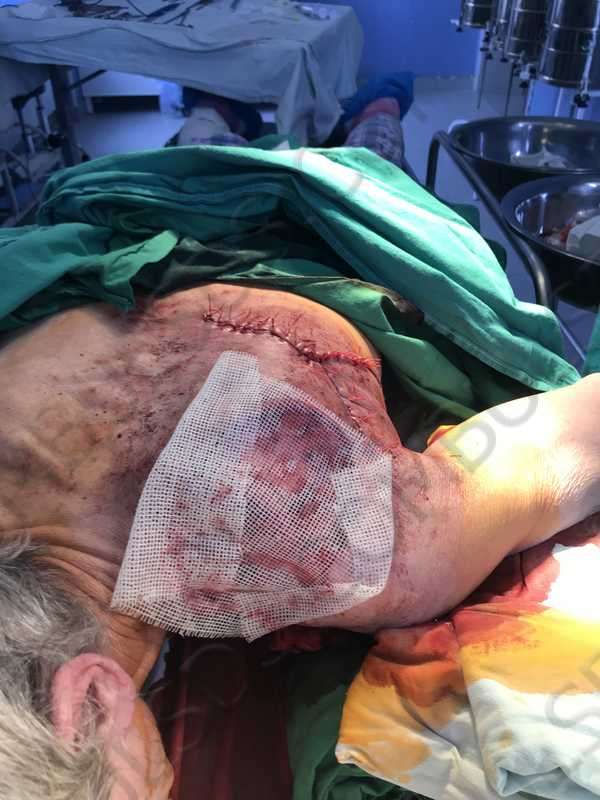
In some cases, surgical excision of a tumor may result in defects that cannot be adequately managed by primary closure, secondary intention healing (granulation), or skin grafting (5). In such cases, the reconstructive ladder suggests a local tissue approach using a flap (5). Rotational flaps allow the mobilization of adjacent tissue, and in some cases multiple rotational flaps can be raised, thereby creating a local tissue reservoir (5).
The Yin-Yang flap is a reconstructive technique commonly used for scalp defect reconstruction (6). It is a frequently utilized technique that allows effective tension vector distribution while enabling the coverage of increasingly large defects (6).
